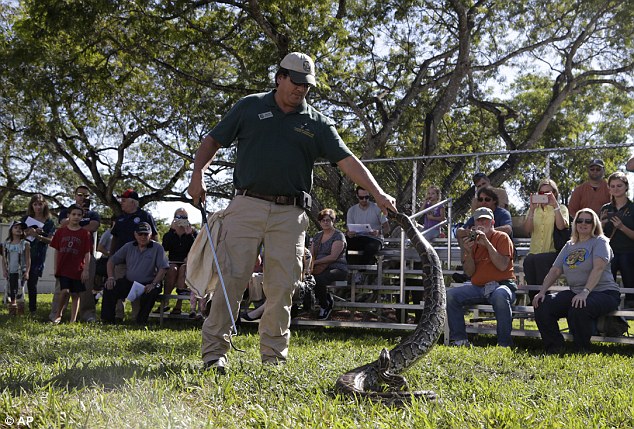
A 20-foot Burmese Python killed a student zookeeper in Caracas on the weekend and was caught trying to swallow its dead human prey when horrified coworkers arrived, Venezuela's El Universal newspaper reported.
The other employees of the Caracas zoo had to beat the serpent to make it release the body of 29-year-old Erick Arrieta, whose head it was swallowing. According to the daily, Arrieta had been working the nightshift alone on Saturday, looking after the reptile section of the zoo. The university biology student had broken the park's rules by entering the cage holding the snake, which had been donated two months ago and was not on public display, according to the zoo's management.
A snake bite on his arm indicated the python had attacked Arrieta before wrapping itself around him and crushing him to death. "The young man underestimated the animal's instinct," said the director general of the Parque del Este zoo, Javier Hernandez. It is the main zoo in Caracas and was built on an old coffee plantation. This zoo includes South American animals such as birds, reptiles, imported felines and elephants. It is rare for constrictor snakes to kill humans, but it has happened on rare occasions. Less than a dozen deaths by constrictor have been recorded in North America in the past 20 years. A man who got bitten by a rattlesnake while trying to take a selfie with it now faces a medical bill of almost £100,000. Todd Fassler's entire arm went purple after he yanked the deadly animal from a bush and as he was composing the perfect shot it unsurprisingly bit him. 10 News To dd Fassler Horrific Injury: Todd Fassler was attacked by a rattlesnake as he tried to pose for a selfie "My whole body was shaking and gyrating," he said. "He literally paralysed my whole body." "My tongue was like out of my mouth, my eyes were off to the side."
Remember the Rattlesnake bite story I did Monday? Guy just sent me this pic of his bill. Uhhhhhhh..... The man from San Diego in California, US, had to empty two hospitals of their anti-venom supply and have the horrific wound repaired, reported ABC's 10 News. Ironically Fassler had a pet rattlesnake for a year but after the attack by a reptile relation on July 4 he has released it into the wild. Getty Western Diamondback Rattlesnake Potentially Deadline: The rattlesnake could have killed Todd, who used up two hospitals' worth of anti-venom to survive However, when his treatment finished he was slapped with a bill of
His insurance company is in negotiations with the hospital and it is as yet unknown if he will have to contribute. The python snake is identified in a number of different ways. It has a series of complex patterns on its skin, often taking the form of irregular diamonds in a number of different colors. The outline of the diamonds on a python snake are usually darker in color, mainly black, whereas the interior of the diamond shape is much lighter in color. Albino pythons are mainly white, with perhaps a yellowish outline of the diamond shapes.
It runs on 5 circuits covering more than 12 destinations across North-West and Central India, mainly centered on Rajasthan between the months of October to April
The Maharajas' Express was voted "The World's Leading Luxury Train" thrice, in a row at The World Travel Awards, 2012, 2013 and 2014. It is the most expensive luxury train in Asia. Maharajas' Express also received the first runner up award in the Specialist Train Operators Category at Conde Nast Travelers Reader Choice Travel Award in 2011.
The Winner of the World's Leading Luxury Train Award 2012,
2013, 2014 & 2015 Maharajas' Express is considered to be one
of the finest luxury trains of India. Well-laden with every
modern facility and often compared to the Orient Express that
Europe, the Maharajas' Express has a décor of oozes out
opulence. You get a chance to explore some of the best and
world- renowned architectural gems of India.
Awards & Accolades:
Winner of CNBC travel award 2010 in the category of
“Best Luxury train”
Awarded as the 1st Runner-up in the Conde Nast readers
choice travel award for the year 2011.
First Indian Luxury train to be voted World Leading luxury
Train at World Travel Award 2012, 2013, 2014 & 2015.
History
The luxury train service was started in March 2010. The Indian Railway Catering and Tourism Corporation Limited (IRCTC) and Cox and Kings India Ltd., had signed a joint venture to set up a company called Royale Indian Rail Tours Ltd. (RIRTL) to oversee the functioning and management of the Maharaja Express. This joint venture was terminated on 12 August 2011 and the train is now being operated exclusively by IRCTC.
Facilities
The Maharajas' Express train has been equipped with modern amenities to offer comfortable on board experiences to the guest, such as pneumatic suspension, live television, wifi, attached bathroom, dining cars, bar, lounge and souvenir shop. Larger cabins have roll-top baths and spacious sitting rooms.
Carriages
The train comprises 23 carriages which include accommodation, dining, bar, lounge, generator and store cars. Accommodation is available in 14 guest carriages with total passenger capacity of 88. The train also has a lounge called the Rajah Club with a private bar, two dining cars and a dedicated bar car. An on-board souvenir boutique offers memorabilia for passengers.The train is also equipped with a water filtration plant.
Guest cabins
14 carriages with 43 individual cabins provide seating and sleeping capacity for 88 guests. There are 20 Deluxe Cabins, 18 Junior Suites, 4 Suites and a Presidential Suite offering 5-star equivalent accommodation. Both the Suites and the Presidential suite has a bathtub in the toilet, in addition to the bath cubicle.
LCD televisions, eco-friendly toilets, direct dial phones, DVD player, internet, individual climate control and electronic safes are available in each guest cabin.
There are 5 carriages in the category of Deluxe Cabins, a total of 20 cabins accommodating 40 passengers (there are 12 Twin bed cabins and 8 double bed cabins). There are a total of 18 cabins in the category of Junior Suites, accommodating 36 passengers (there are 12 Twin bed Cabins and 6 Double bed cabins). Additionally, there are four Suites available, having large separate sitting and sleeping areas. A Presidential suite built on an entire rail carriage, incorporating a separate sitting-cum-dining room, a master bedroom and bathroom with shower and bathtub, a twin bedroom and bathroom with shower. The Maharajas' Express Presidential Suite is the first such a rail carriage of its kind in the world for commercial use.
Dining and bar coaches
The train has two dining cars designed for full five dining service, each with a seating capacity of 42 guests at a time so that all the guests dine together. The train has a state of the art kitchen car designed to provide a range of cuisines. The restaurants are named Rang Mahal and Mayur Mahal. Mayur Mahal (the Peacock restaurant) has peacock feather theme in its décor. Restaurant menus include traditional Indian cuisines along with Continental, Chinese and International cuisines.
A dedicated bar carriage, the Rajah Club, offers wines, liqueurs, spirits and beers along with snacks and starters and a lounge cum bar called the Safari bar equipped with a multilingual library and board games offers a casual lounge experience. The tariff includes drinks on board, the drinks served in the bar are IMFL ( Indian Manufactured foreign Liquor)
Itineraries
In the year 2012, IRCTC introduced five new journeys of the Maharajas' Express, of which two are short-term Golden Triangle (Delhi, Jaipur and Agra) tours and rest three are week-long pan-Indian voyages.
Heritage of India Duration: 7 Nights / 8 Days Destinations Covered: Mumbai – Ajanta – Udaipur – Jodhpur – Bikaner – Jaipur – Ranthambore – Agra - Delhi
Treasures of India Duration: 3 nights / 4 days Destinations Covered: Delhi – Agra – Ranthambore – Jaipur – Delhi.
Gems of IndiaDuration: 3 Nights / 4 Days Destinations Covered: Delhi – Agra – Ranthambore – Jaipur – Delhi
The Indian Splendour Duration: 7 Nights OR 8 Days Destinations Covered: Delhi – Agra – Ranthambore – Jaipur – Bikaner – Jodhpur – Udaipur – Balasinor – Mumbai
Awards/Recognition
Voted World Leading Luxury Train at World Travel Award 2012 2013 & 2014 1st Runner up in the Specialist Train Operators Category at Conde Nast Traveler's Reader Choice Awards 2011 Adjudged Best Luxury Train at CNBC Travel Awards 2010
My all other videos https://www.youtube.com/user/ramanmgr/videos
LIKEand SUBSCRIBE
Dream Train in India Maharaja Express by Indian Railway
Your tweets could be a treasure for hacker BE SAFE !
Dr. Bhimrao Ramji Ambedkar (14 April 1891 – 6 December 1956), popularly known as Babasaheb, was an Indian jurist, economist, politician and social reformer who inspired the Dalit Buddhist movement and campaigned against social discrimination against Untouchables (Dalits), while also supporting the rights of women and labour.
He was Independent India's first law minister and the principal architect of the Constitution of India
Shivaji Bhonsle 1627/1630 – 3 April 1680), also known as Chhatrapati Shivaji Maharaj, was an Indian warrior king and a member of the Bhonsle Maratha clan.
Shivaji carved out an enclave from the declining Adilshahi sultanate of Bijapur that formed the genesis of the Maratha Empire.
In 1674, he was formally crowned as the Chhatrapati (Monarch) of his realm at Raigad.
कैमरे का बटन दबाते ही गरीब की बेटी फोटोग्राफर वाले से यूँ बोली
कैमरे का बटन दबाते ही गरीब की बेटी फोटोग्राफर वाले से यूँ बोली
खींच कर तस्वी मेरे मुकद्दर की दुनिया में तमाशा न बनाओ बदन उघरा है बचपन से गरीबी का इसकी न नुमाइश लगाओ सम्भाला होश जब से ढ़ूंढ़ रही हूँ दर बदर , मुझे " भारत माता"का पता बताओ
कर लेना कैद कैमरे में ज़रा ठहरो " भारत माता " को अपनी व्यथा तो सुना दूँ कचरा बीन कर खाना , पुलिया के नीचे रहने का पता तो बता दूँ अमीरों के महलों में रहने वाली " भारत माता" को कड़कती सर्दी में नंगे बदन का अहसास तो करा दूँ कैसे रहते है उसके अपने बच्चे अपने ही देश में आजाद देश में गरीबों की दुर्दशा तो दिखा दूँ
कहाँ है बचपन के खेल खिलौने किधर हैं झूलो के बाग कहाँ है मेरा स्कूल का बस्ता किधर हैं मेरी किताब में भी तो हूँ तेरी अपनी बेटी
कहाँ है मेरी कलम दवात भारत माता की जय कहने वालों मुझे से आँखे तो मिलाओ कहाँ छुपी है भारत माता उसका पता बताओ
Switch the camera The daughter of poor Simply quote from the photographer
Pull Tswi of my fate Make no spectacle in the world Body is Ugra From childhood poverty The exhibition not apply Took senses Badar since'm looking rate, I am "Mother India" tell out
Capture camera take Just wait " Mother India " Then recite their story to Bean food garbage, Find below the bridge, then let me tell Rich in palaces Dwelling "Bharat Mata" the
Thunder in winter Let me give you a feeling of naked How to live her own child In their own country In a free country So let me show the plight of the poor Where childhood games, toys Where is the garden of Julo Where is my school satchel Where is my book I'm also your daughter
Where's my pen inkstand Bharat Mata Ki Jai those speaking I have eyes to shake Where is the hidden Mother India Tell her address
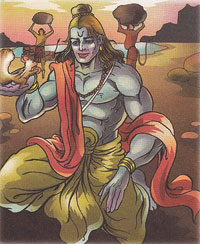
Lord Rama wanted to cross the bridge to Lanka in order to save Sita from Ravana's clutches. He sat down to pray to the sea god. The sea god, Samudra, arose from the depths of the sea and told Rama to build a bridge across the sea.
All the monkeys got busy building the bridge by placing boulders.
tiny squirrel was watching everything from his burrow. He decided to help Rama. He began picking sand and scattered twigs and scurried back and forth from the shore to the sea. Little by little the squirrel had gathered an entire heap.
Rama noticed the dedication of this tiny creature. Picking it up on his palm, he warmly stroked the animal with his three fingers. Since then, it is believed that squirrels have three lines on their body.
Mumbai(Marathi: मुंबई)[1], a cosmopolitan metropolis, earlier known asBombay, is the largest city inIndiaand the capital of Maharashtrastate. Mumbai was originally a conglomeration of seven islands on theKonkancoastline which over time were joined to form the island city of Bombay. The island was in turn joined with the neighbouring island of Salsette to formGreater Bombay. The city has an estimated metropolitan population of 21 million (2005), making it one of the world's most populous cities.
Mumbai is big. It’s full of dreamers and hard-labourers, starlets and gangsters, stray dogs and exotic birds, artists and servants and fisherfolk andcrorepatis(millionaires) and lots and lots of people. It has India’s most prolific film industry, some of Asia’s biggest slums (as well as the world’s most expensive home) and the largest tropical forest in an urban zone. Mumbai isIndia’s financial powerhouse, fashion epicentre and a pulse point of religious tension. It’s even evolved its own language, Bambaiyya Hindi, which is a mix of…everything.
The word 'Kuppa' means a tunnel or cave, and "Ghat" means place located on a river-bank. Accordingly, there is a cave at Kuppaghat which has been rendered famous and immortalized byMaharshi Mehi Paramhans, the legendary exponent of Santmat. Maharshi Mehi practicedsurat shabd yogaor the Yoga of Inner Sound for several months here in this cave and later constructed his Ashram also; several yogis or spiritual aspirants can still be seen practicing the Yoga of Inner Light & Sound in this dark cave completely insulated from the din & bustle and brightness of the outside world.Maharshi MehiAshram blossomed under his dynamic leadership to become the national headquarters of Akhil Bharatiya Santmat-Satsang. It has an aesthetically laid out garden and orchard beautifully punctuated with sculptures, paintings and quotes having spiritual significance like a cottage showing Lord Ram visiting great female devotee Shabri and killing of Jatayu, the vulture, at the hands of the demon king Ravana.
Maharshi Mehi was born on28 April 1885 in a small village ofBihar, Majhua (Khoskhsi Sharanpur), India. From very early age he was a seeker of truth and had an intense thirst for inquiry. His search finally to the feet of his teacher, Baba Devi Sahab, in 1909. As directed by his teacher, Mehi spent many years in intense meditation and eventually located atKuppaghaton the banks of theGangesnear Bhagalpur in the state of Bihar.
Maharshi Mehi was born on the fourteenth day of theShukla PakshaofVaisakha(28 April 1885) at his maternal grandparents’ home in Khokhsi Shyam Village, inSaharsa,Bihar, India. His father, Babujan Lal Das, a deeply religious man, was a resident of the village named Sikligarh Dharahra, a place that was soon to become immortal and sacred in the hearts of millions of devotees of Mehi and which now houses an Ashram which is regarded as amongst the holiest of places associated with Sant Mat. Sikligarh Dharahra comes under Banmankhi police Station in the District ofPurneain the state of Bihar, India.
Mahrshi Mehi Paramhansji Maharaj (1885–1986) :- Among saints Maharshi Mehi Paramhansji Maharaj is the main figure in modern era. He was born at village- Khokhshi Shyam (Majhua) Dist. - Madhepura, Bihar (India) in 1885 a day before Baishakhi Purnima. His paternal village is Sikaligarh Dharhara (Banmankhi) Dist. - Purnea, Bihar (India). He was religious from his childhood. Once he was answering a question from the poem ‘Builders’ in matriculation examination 1904. By unborn power he left the examination-hall and set out in search of suprime goal of life i.e. ‘God Ram’. After a long search he met a great spiritual preceptor ‘Baba Devi Sahab’. Under the direction of this teacher he understood Santmat exactly. He had a self divine realisation in meditation for 18 months in the cave of Kuppaghat, Bhagalpur (Bihar). He worte down his base book of Santmat - ‘Satsang-yoga’. Many other books were also composed by him in Hindi that gives a solid base to Santmat. He spread Santmat extensively moving on troublesome vehicles even in old age. Among regular meditation and satsang he left this earth on 8 June 1986 completing the age of 101 years.
Sant Bhujangi Das or Bhujangi Baba, as he was called, was a disciple of Meinhi Maharaj [Maharshi Mehi Paramhans] of Bhagalpur, Bihar, India, who was a disciple of Baba Devi Sahib. He was born on 5 Jan 1922 at a place called Barai Chak, in village Patam, District Munger, Bihar, India. He studied up to 7th standard only, which, in the then existing environment was better than average.
At that time, child marriage was the norm in India, although the girl used to go to her husband’s house only after puberty. As per custom, he too was married at the age of seven or eight years but he was never interested in the life of a householder and the marriage came to an end when he was approximately 25 years old. He received his initiation into Manas Jap (mental recitation), Manas Dhyan (meditation on a form) and Drishti Sadhan (the exercise of sight) in 1939 from Meinhi Maharaj and initiation into Surat Shabd Yoga (Yoga of light and sound) 15 years later.
He expressed his desire to renounce the world and live as an ascetic to his Guru. But he was told to work and earn his livelihood as was done by his Guru Meinhi Maharaj and Baba Devi Sahib before him, in keeping with the tenets of Santmat (Path of Saints). Our Guru, Meinhi Maharaj used to say that if you live on food provided by others then whatever spiritual merit you gain will also get distributed. So Bhujangi Baba worked from 1941 to 1971 in Railway Workshop of East India Railway at Jamalpur, about 8 kms from Patam.
He was a man of few words and would not speak to anyone so easily and in day to life, he would never tell anybody about his spiritual pursuit. Soon he left his home and started living in a thatch hut in the fields, about 2 kms from the village. He used to go for his job from there itself and avoid contact with people. Many a time he would go into the wilderness of Rishi Kund, a place of warm water springs and immense natural beauty, about 8 kms from Patam and do his spiritual practices. In 1948–49, after the death of his father, he took a small plot of land out of his ancestral property and constructed an ashram and started living there. It consisted of two rooms for living and a hall for Satsang, all mud construction. Today the ashram has come up and has concrete structures for living accommodation as well as a prayer hall.
Bhujangi Baba handed over the ashram to a trust. During his life time itself he nominated Swami Ratneshwarananda or Ratan Baba, my Guru (then Dr Ram Ratan Lal Sharma) to run the ashram after him. He was a Trikaldarshi (the one who knows Tri that is three Kal that is time or the person who knows past, present and future.) One day, he told Ratan Baba to show him his right hand. On seeing his hand he commented, “As per the lines of your hand, your Luck Line is very good but your Life Line is very short.” Ratan Baba replied, “Yes sir, as per lines of my hand I have a short life.” Bhujangi Baba, while scratching Ratan Baba’s hand with the nail of his right thumb said, “If a Mangal Rekha (Mars line or an auspicious line) develops like this, your life would become longer.” Sure enough, after some time, my Guru’s hand had a new line at exactly the same spot which can be seen even today.
Bhujangi Baba lived a simple, frugal life and worked hard at his job. He put his entire earnings into construction of the ashram, which is now being looked after by my Guru.